
When you’re buying a T-shirt, you probably look at the fit, color, design, fabric, and price. But there’s another detail that can tell you a surprising amount about how a T-shirt will feel and perform: GSM.
You may have seen T-shirts described as 160 GSM, 180 GSM, 200 GSM, or even 240 GSM. But what do those numbers actually mean?
GSM stands for Grams per Square Meter. In simple terms, it tells you how much one square meter of fabric weighs.
The higher the GSM, the more fabric is generally present in that square meter. This usually means the fabric feels heavier, thicker, and more substantial. However, higher GSM doesn’t automatically mean better quality.
Understanding GSM can help you choose a T-shirt that matches your preferred comfort, climate, fit, and style.
Let’s break it down.
What Does GSM Mean in T-Shirts?

GSM stands for Grams per Square Meter (g/m²).
It is a measurement of fabric weight. If a fabric has a GSM of 180, it means one square meter of that fabric weighs approximately 180 grams.
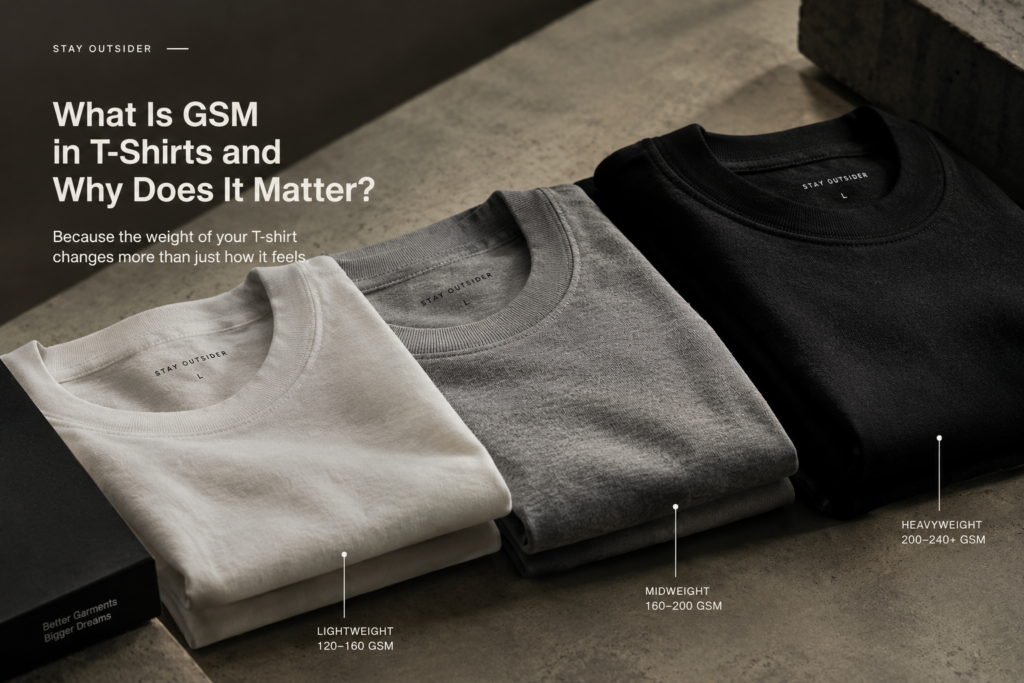
For T-shirts, GSM is commonly used to describe whether the fabric is lightweight, midweight, or heavyweight.
For example:
- 120–160 GSM: Lightweight
- 160–200 GSM: Midweight
- 200–240+ GSM: Heavyweight
These ranges aren’t strict industry rules. Different manufacturers and fabric types can feel very different even when they have the same GSM.
A 180 GSM cotton T-shirt, for example, can feel completely different from a 180 GSM polyester T-shirt because the fiber, construction, weave, and finishing process also affect the final fabric.
That’s why GSM should be treated as a useful indicator—not the entire quality story.
How Is T-Shirt GSM Measured?
GSM is calculated by determining the weight of a specific area of fabric.
Manufacturers can take a precisely measured piece of fabric, weigh it, and calculate its weight per square meter.
The basic idea is simple:
GSM = Fabric weight ÷ Fabric area
The result tells manufacturers and buyers how heavy the fabric is relative to its size.
You don’t need to calculate GSM yourself when shopping for a T-shirt. Brands and manufacturers usually provide the specification.
What matters is understanding what that number means when you’re actually wearing the shirt.
What Does Different T-Shirt GSM Feel Like?
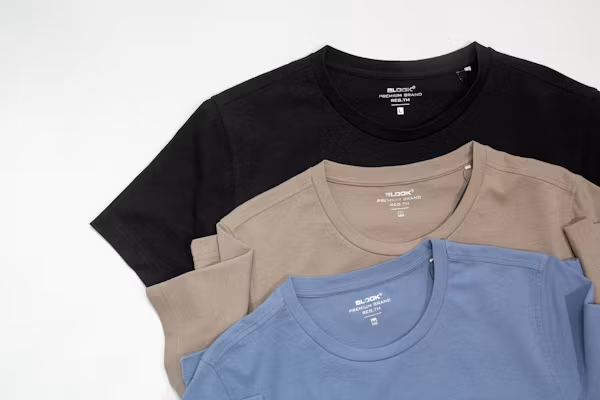
Different GSM levels create noticeably different experiences.
Lightweight T-Shirts
Lightweight T-shirts usually have a thinner, softer, and more breathable feel.
They’re useful for:
- Hot weather
- Layering
- Everyday casual wear
- Sports and active use
- People who prefer a lighter feel
The downside is that very lightweight fabric may be more transparent, less structured, and potentially less durable depending on the fabric construction.
Midweight T-Shirts
Midweight T-shirts are often the most versatile option.
They provide a balance between:
- Comfort
- Breathability
- Structure
- Durability
- Everyday usability
A midweight T-shirt can work well throughout the year and is often suitable for people who don’t want a shirt that feels either too thin or too heavy.
Heavyweight T-Shirts
Heavyweight T-shirts have a thicker and more substantial feel.
They generally offer:
- More structure
- A stronger silhouette
- A premium, substantial feel
- Better drape for certain oversized fits
- Greater layering potential
Heavyweight T-shirts are particularly popular in modern streetwear because the fabric can help create a more structured and intentional silhouette.
But heavier doesn’t always mean more comfortable. In a hot and humid climate, a very heavyweight T-shirt may feel warmer than a lightweight alternative.
Does Higher GSM Mean Better Quality?
No.
This is one of the biggest misconceptions about GSM.
A 240 GSM T-shirt isn’t automatically better than a 180 GSM T-shirt.
GSM only tells you about fabric weight. It doesn’t tell you everything about the fabric’s quality.
Other factors matter, including:
- Fiber quality
- Yarn quality
- Fabric construction
- Knitting technique
- Stitching
- Finishing
- Shrinkage control
- Color fastness
- Print quality
- Manufacturing consistency
Think of GSM as one piece of the puzzle.
A well-made 180 GSM T-shirt can be significantly better than a poorly manufactured 240 GSM T-shirt.
The goal isn’t to find the highest GSM possible. The goal is to find the right GSM for the product and its intended use.
How GSM Affects T-Shirt Comfort

Fabric weight has a direct effect on how a T-shirt feels.
Lightweight fabrics generally allow more airflow and can feel easier to wear in hot conditions.
Heavier fabrics tend to feel more substantial and can provide a stronger, more structured fit.
But comfort depends on more than weight.
Fiber composition, fabric construction, softness, moisture management, fit, and finishing all influence how comfortable a T-shirt feels.
For example, a lightweight cotton T-shirt may feel extremely comfortable during summer, while a heavyweight cotton T-shirt may feel better when you’re looking for structure and a more substantial streetwear silhouette.
There isn’t one GSM that is universally the most comfortable.
How GSM Affects Durability
GSM can influence durability because heavier fabrics generally contain more material within a given area.
However, this doesn’t mean that every heavyweight T-shirt will last longer.
Durability also depends heavily on:
- Yarn strength
- Stitching quality
- Fabric construction
- Seams
- Washing conditions
- Garment finishing
- Overall manufacturing quality
A high-GSM shirt with poor stitching can still develop problems.
On the other hand, a well-constructed midweight T-shirt can remain in excellent condition for years with proper care.
So if you’re buying based on durability, don’t ask only, “What’s the GSM?”
Ask, “How well is the entire garment made?”
How GSM Changes the Fit and Look
This is where GSM becomes particularly interesting for streetwear.
Fabric weight can change how a T-shirt sits on your body.
A lightweight fabric tends to fall more naturally and can create a softer, more relaxed appearance.
A heavyweight fabric generally holds more structure.
This can be especially noticeable with oversized T-shirts.
A properly designed heavyweight oversized T-shirt can create:
- Broader-looking shoulders
- A stronger body shape
- More defined sleeves
- A cleaner silhouette
- A more substantial overall appearance
That’s one reason heavyweight T-shirts have become popular in contemporary streetwear.
However, simply making an oversized T-shirt heavier doesn’t guarantee a good fit.
Pattern design still matters.
The shoulder width, sleeve length, body length, neck opening, and overall proportions all need to work together.
GSM and Different T-Shirt Fabrics
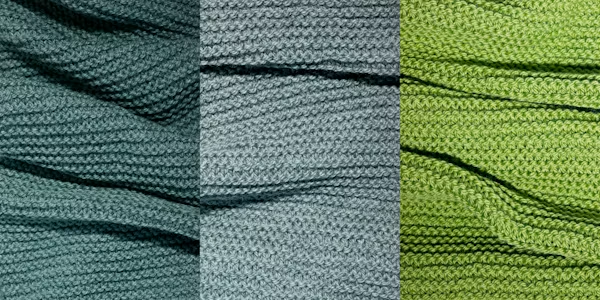
GSM should always be considered alongside the fabric composition.
Cotton
Cotton T-shirts can come in a wide range of GSM levels.
Cotton is popular because it is breathable, comfortable, and versatile.
The type and quality of cotton also matter. Two cotton T-shirts with identical GSM can feel very different depending on the yarn and construction.
Polyester
Polyester is lightweight, durable, and commonly used in performance and activewear.
A polyester T-shirt with a particular GSM can behave very differently from a cotton T-shirt with the same GSM.
Cotton Blends
Blended fabrics combine different fibers to create specific characteristics.
For example, a cotton-polyester blend may be designed to balance softness, durability, weight, and moisture management.
Again, GSM alone doesn’t tell you how the finished garment will perform.
What GSM Is Best for Indian Weather?
India has a wide range of climates, so there’s no single perfect GSM for everyone.
For hot summer conditions, lightweight and midweight T-shirts are generally easier to wear.
A range around 160–190 GSM can provide a useful balance between breathability and structure for everyday casual wear.
For cooler weather, layering, or a more structured streetwear look, heavier fabrics can make more sense.
However, local climate matters.
Someone living in a hot, humid coastal city may prefer a very different T-shirt weight from someone living in a cooler region.
The best choice is the one that matches how and where you actually plan to wear the T-shirt.
What GSM Should You Choose for Streetwear?
If you’re specifically interested in streetwear, midweight to heavyweight T-shirts are often worth considering.
Something around 180–240 GSM can provide enough structure to create a stronger silhouette without necessarily becoming uncomfortably heavy.
For oversized streetwear, heavyweight fabrics can be particularly effective because they help the garment maintain its shape.
But don’t choose a GSM simply because a number sounds premium.
A 220 GSM T-shirt with poor proportions isn’t going to magically become good streetwear.
Fit comes first. Fabric weight supports the fit.
That’s an important distinction.
GSM vs Fabric Quality: Why You Shouldn’t Look at GSM Alone
Imagine two T-shirts.
T-shirt A is 220 GSM but has rough fabric, weak stitching, poor shrinkage control, and an uncomfortable collar.
T-shirt B is 180 GSM but uses better-quality yarn, has clean stitching, a well-designed pattern, a comfortable collar, and excellent finishing.
Which one is better?
The answer isn’t automatically T-shirt A.
This is why smart clothing buyers look beyond a single specification.
GSM tells you how heavy the fabric is.
It doesn’t tell you:
- How soft it is
- How breathable it is
- How it will shrink
- How the color will hold
- How strong the seams are
- How it will feel after repeated washing
- How well the garment is constructed
A good T-shirt is the result of several decisions working together.
How to Choose the Right GSM T-Shirt
Before buying a T-shirt, think about five things:
1. Climate
If you live somewhere hot, a lighter fabric may be more practical.
2. Fit
Oversized and boxy T-shirts often benefit from more structured fabrics.
3. Usage
For everyday summer wear, lightweight or midweight fabrics can work well.
For streetwear, layering, or a more substantial look, heavier fabrics may be preferable.
4. Personal Preference
Some people love the barely-there feel of lightweight cotton.
Others prefer a T-shirt that feels substantial the moment they put it on.
Neither preference is wrong.
5. Overall Construction
Never judge a T-shirt by GSM alone.
Look at the fabric, stitching, collar, fit, finishing, and construction as a complete package.

Final Thoughts
GSM is a simple number, but it can tell you a lot about a T-shirt.
It helps you understand whether a fabric is likely to feel lightweight, balanced, or substantial. It can influence comfort, structure, drape, and the overall appearance of a garment.
But here’s the important part:
Higher GSM doesn’t automatically mean higher quality.
A great T-shirt isn’t created by chasing the biggest number.
It’s created by choosing the right fabric weight, combining it with good materials and construction, and designing the garment around how people actually want to wear it.
For everyday wear, midweight fabrics can offer a strong balance between comfort and durability. For structured streetwear and oversized silhouettes, heavyweight fabrics can create a more distinctive look.
So the next time you see “180 GSM” or “220 GSM” on a T-shirt, you’ll know what you’re looking at.
Not a quality score.
Not a marketing trick.
Just one useful measurement that helps explain how the fabric is built and how it may feel on you.
And when you’re choosing what to wear, that’s information worth knowing.